
Freedom Church Market Drayton Safeguarding Policy
| Role | Name | Contact |
| Safeguarding Officer | Vanessa Savill | nessisav@gmail.com |
| Deputy Safeguarding Officer | Carolyn Lawrence | Carolyn.lawrence413@gmail.com |
| Thirty One: Eight | Helpline | 03030031111 |
Please note personal email addresses should not be used for safeguarding reports or other safeguarding enquiries due to the inability to restrict access to confidential information if/when the officer is no longer in this position of trust. If you need access to an alternate email address please contact the office.
Introduction
FCMD is a Free Methodist Church in the UK & Ireland. Our Safeguarding Policy outlines our practices and the approach to handling concerns raised in relation to members of FCMD.
As a church we are committed to complying with the standards outlined by the Charity Commission and safeguarding organisation Thirty One: Eight and we as the local church take responsibility for undertaking appropriate DBS checks for our staff and volunteers in accordance with the latest guidelines.
Along with details of the organisation and a statement of intent and commitment to safeguarding, our policy covers the following sections:
Section 1. Organisation details
Section 2. Recognising and responding appropriately to an allegation or suspicion of abuse
Section 3. Prevention
Section 4. Pastoral care
Section 5. Practice guidelines and safeguarding procedure
Section 6. Working in partnership
Appendices
#1 Definitions of abuse
#2 Leadership safeguarding statement
#3 Cause for concern form
#4 Procedure and Allegation Processes
#5 Operational Guidelines
Safeguarding Policy
Section 1
Details of the organisation
Name: Freedom Church Market Drayton
Address: Normally meeting at Festival Drayton Centre, Frogmore Road, Market Drayton TF9 3AX
Tel No: 07903 533058
Email address: info@mdfreedom.church
Charity Number: Kingdom Ministires 1192753
The following is a brief description of our organisation and the type of work/activities we undertake with children and adults who have care and support needs:
Freedom Church Market Drayton is committed to fulfilling the Great Commission by making disciples of Jesus Christ. Our gatherings are centred around worship and teaching, inviting individuals to deepen their relationship with God and serve their community.
We are a newly planted church, that is affiliated with the Free Methodist Church of UK & Ireland which is a registered charity (number: 518173)
We have appointed a Designated Safeguarding Lead, this person is Vanessa Savill.
Our Commitment
The Leadership of FCMD recognise the need to provide a safe and caring environment for children, young people and adults. We acknowledge that children, young people and adults can be the victims of physical, sexual and emotional abuse, and neglect. We accept the UN Universal Declaration of Human Rights and the International Covenant of Human Rights, which states that everyone is entitled to “all the rights and freedoms set forth therein, without distinction of any kind, such as race, colour, sex, language, religion, political or other opinion, national or social origin, property, birth or other status”. We also concur with the Convention on the Rights of the Child which states that children should be able to develop their full potential, free from hunger and want, neglect and abuse. They have a right to be protected from “all forms of physical or mental violence, injury or abuse, neglect or negligent treatment or exploitation, including sexual abuse, while in the care of parent(s), legal guardian(s), or any other person who has care of the child.” As a Leadership we have therefore adopted the procedures set out in this safeguarding policy in accordance with statutory guidance. We are committed to building constructive links with statutory and voluntary agencies involved in safeguarding.
FCMD undertakes to:
- Endorse and follow all national and local safeguarding legislation and procedures, in addition to the international conventions outlined above.
- Provide on-going safeguarding training for all our workers and will regularly review the operational guidelines (Appendix 6).
- Ensure that any premises where charitable activities are undertaken meet the requirements of the Equality Act 2010 and all other relevant legislation, and that it is welcoming and inclusive.
- Support our Designated Safeguarding Coordinator(s) in their work creating and adhering to safeguarding policies and in any action they may need to take in order to protect children and vulnerable adults.
Section 2
Recognising and responding appropriately to an allegation or suspicion of abuse
Understanding abuse and neglect
Defining child abuse or abuse against an adult is a difficult and complex issue. A person may abuse by inflicting harm, or failing to prevent harm. Children and adults in need of protection may be abused within a family, an institution or a community setting. Very often the abuser is known or in a trusted relationship with the child or adult.
In order to safeguard those in our places of worship and organisations we adhere to the UN Convention on the Rights of the Child and have as our starting point as a definition of abuse, Article 19 which states:
- States Parties shall take all appropriate legislative, administrative, social and educational measures to protect the child from all forms of physical or mental violence, injury or abuse, neglect or negligent treatment, maltreatment or exploitation, including sexual abuse, while in the care of parent(s), legal guardian(s) or any other person who has the care of the child.
- Such protective measures should, as appropriate, include effective procedures for the establishment of social programmes to provide necessary support for the child and for those who have the care of the child, as well as for other forms of prevention and for identification, reporting, referral, investigation, treatment and follow-up of instances of child maltreatment described heretofore, and, as appropriate, for judicial involvement.
Also for adults the UN Universal Declaration of Human Rights with particular reference to Article 5 which states:
“No one shall be subjected to torture or to cruel, inhuman or degrading treatment or punishment.”
Detailed definitions, and signs and symptoms of abuse, as well as how to respond to a disclosure of abuse, are included in the appendices of our policy see Appendix 1.
Safeguarding awareness to aid the recognition of abuse
We are committed to on-going safeguarding training and development opportunities for all workers, developing a culture of awareness of safeguarding issues to help protect everyone. Designated Safeguarding Officers within our church are responsible for ensuring that all workers receive recognised safeguarding training on a regular basis. Our Designated Safeguarding Officers will also ensure that children and adults with care and support needs are provided with information on where to get help and advice in relation to abuse, discrimination, bullying or any other matter where they have a concern.
Responding
Under no circumstances should a worker carry out their own investigation into an allegation or suspicion of abuse.
Documenting concerns:
All suspicions should be taken seriously, and therefore everyone should observe and record. Records should be made as soon as possible, with time, date, witnesses and observation. Cause of Concern, and other forms are found in the appendices. (Appendix3).
The person in receipt of allegations or suspicions of abuse should report concerns as soon as possible to:
Name: Vanessa Savill (Hereafter referred to as the Safeguarding officer)
Tel: 07903 533058 Email: info@mdfreedom.church
The above is nominated by the Leadership to act on their behalf in dealing with the allegation or suspicion of neglect or abuse, including referring the matter on to the statutory authorities.
In the absence of the Safeguarding Officer or, if the suspicions in any way involve the Safeguarding Co- ordinator, then the report should be made to:
Name: Carolyn Lawrence (hereafter the safeguarding deputy)
Tel: 07903 533058
Email: info@mdfreedom.church
If the suspicions implicate both the Safeguarding Co-ordinator and the Deputy, then the report should be made in the first instance to:
| Thirty One: Eight | Helpline | 03030031111 |
Or alternatively contact Social Services or the police.
Responding to Allegations of Abuse
Under no circumstances should a worker carry out their own investigation into an allegation or suspicion of abuse. Following procedures as below:
- The Safeguarding Co-ordinator may need to inform others depending on the circumstances and/or nature of the concern
- Trustees responsible for safeguarding may need to liaise with the insurance company or the charity commission to report a serious incident.
- Designated officer or LADO (Local Authority Designated Officer) if the allegation concerns a worker or volunteer working with someone under 18.
Suspicions must not be discussed with anyone other than those nominated above. A written record of the concerns should be made in accordance with these procedures and kept in a secure place.
Whilst allegations or suspicions of abuse will normally be reported to the Safeguarding Co-ordinator, the absence of the Safeguarding Co-ordinator or their deputy you should not delay referral to Social Services, the Police or taking advice from Thirty One: Eight.
The Leadership will support the Safeguarding Co-ordinator and respect their decisions within their role and accept that any information they may have in their possession will be shared in a strictly limited way on a need to know basis.
It is, of course, the right of any individual as a citizen to make a direct referral to the safeguarding agencies or seek advice from Thirty One: Eight, although the Leadership hope that members of this place of worship will use this procedure. If, however, the individual with the concern feels that the Safeguarding Co-ordinator has not responded appropriately, or where they have a disagreement with the Safeguarding Co-ordinator(s) as to the appropriateness of a referral they are free to contact an outside agency directly. We hope by making this statement that the Leadership demonstrates its commitment to effective safeguarding and the protection of all those who are vulnerable.
The role of the safeguarding coordinator is to collate and clarify the precise details of the allegation or suspicion and pass this information on to statutory agencies who have a legal duty to investigate.
The person in receipt of allegations or suspicions of abuse should report concerns as soon as possible to the Safeguarding Officer who is nominated by the trustees to act on their behalf in dealing with the allegation or suspicion of neglect or abuse, including referring the matter on to the statutory authorities.
In the absence of the Safeguarding Officer or, if the suspicions in any way involve them, then the report should be made to their deputy. If the suspicions implicate both the deputy and the Safeguarding Officer, then the report should be made in the first instance to Thirty One: Eight. Alternatively contact Social Services or the police.
For further information around actions taken following allegations of abuse please follow Procedure and Allegation Processes (Appendix 5). See also Practice Guidelines and Safeguarding Procedure (Section 5).
Section 3
Prevention
Safer recruitment practices will be followed in the appointment of employees and volunteers (hereinafter jointly referred to as workers) of FCMD. Disclosure and barring checks will be carried out where necessary. All workers will have access to our Safeguarding Policy and know how to report concerns. See Practice Guidelines (Section 5).
Where workers from outside of the UK are considered for roles within the church, then necessary background checks on those applying to work with children/vulnerable adults will be carried out, e.g. individuals will be required to ‘fit person’ checks from their home country as well as references from there.
Section 4
Pastoral Care
FCMD is aware that all pastoral relationships are ones in which the worker is in a position of power and influence over others by the nature of their work or activity. This is especially significant when the worker is engaging with vulnerable groups. FCMD recognise the importance that all pastoral carers know what abuse is, how to recognise the possible signs and indicators , and how to respond to concerns. Pastoral workers should:
- Be supervised and accountable to others
- Be clear about the limits of their role
- Refer people on to those that can help
- Report any safeguarding issues that arise
- Be aware of the risk of over-dependency in pastoral relationships (This can apply both ways).
- Avoid any behaviour that may give the impression of favouritism or of a ‘special’ relationship.
Be clear about the boundaries of their role. e.g. Where workers are providing mentoring or coaching roles this should be clearly defined.
Supporting those affected by abuse
The Leadership is committed to offering pastoral care, working with statutory agencies as appropriate, and supporting all those who have been affected by abuse who have contact with or are part of our church.
Working with offenders
When someone working with or volunteering as part of the church, is known to have abused children, or is known to be a risk to vulnerable adults the Leadership will supervise the individual concerned and offer pastoral care, but in its safeguarding commitment to the protection of children and vulnerable adults, set boundaries for that person which they will be expected to keep.Section 5
Clear policies and a code of behaviour for the individual will be in place that the individual must follow. This will help protect the vulnerable and lessen the possibility of the person being wrongly suspected of abuse in the future. Contracts with sex offenders will be drawn up which will give details of both the boundaries expected of the individual and the support offered to them. It will be tailored specifically to individual circumstances and informed by risk assessments from the statutory agencies.
Practice Guidelines and Safeguarding Procedure
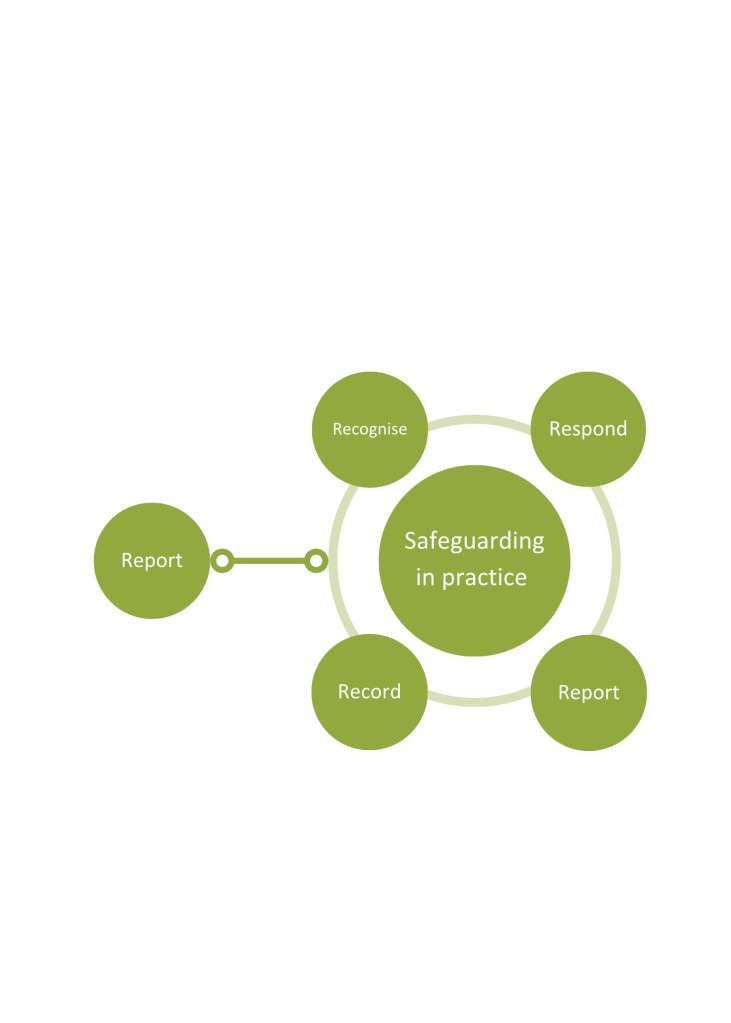
The 5 R’s of Safeguarding
Everyone is responsible for: recognising, responding, recording and reporting. The Safeguarding Officer is responsible for reporting.
Chain of Report:
- Cause of concerns can be recorded and raised by anyone
- Records should be passed directly to the Safeguarding Officer
- If the record concerns the Safeguarding Officer, report to the deputy.
- The FCMD Safeguarding Officer will report to the necessary agencies or make the decision to just log the details for the time being if criteria is not met for referral.
Recording a disclosure
Effective Listening
Ensure the physical environment is welcoming, giving opportunity for the person to talk in private but try your best to make sure others are aware the conversation is taking place.
- It is especially important to allow time and space for the vulnerable person to talk
- Above everything else listen without interrupting
- Show acceptance of what they say (even if the story may sound unlikely) by reflecting back words or short phrases they have used to confirm what you heard is correct
- Try to remain calm, even if on the inside you are feeling something different
- Be honest and don’t make promises you can’t keep regarding confidentiality
- If they decide not to tell you after all, accept their decision but let them know you are always ready to listen
- Use language that is age appropriate and clearly understandable for those with disabilities, if you need help communicating with a person who you aren’t able to communicate clearly with, e.g. if they are deaf or speak a foreign language, let them know you are going to ask someone to help.
Helpful Responses
- You have done the right thing in telling me
- I am glad you have told me
- I will try to help you
Don’t Say
- Why didn’t you tell anyone before
- I can’t believe it
- Are you sure this is true
- Why? How? When? Who? Where?- Don’t investigate
- I am shocked, don’t tell anyone else
Obtaining Information for Records
- Stay calm, listen carefully and allow the person to continue at his or her own pace;
- Make the person aware that you will probably have to share the information disclosed with others, particularly if a crime has been committed, seek to get their permission to do so;
- Re-assure the person that they have done the right thing in telling you;
- Ask questions for clarification only and avoid ‘leading’ questions that will suggest a particular answer;
- Tell them what you might do next and seek to get their permission to act on the information they have given you.
Recording Your Concerns
- You must make a report to the Designated Safeguarding Lead within 24 hours
- A report can be made via (Insert process or link to forms) either a written or electronic report and keep it securely until it can be passed to the Designated Safeguarding Lead.
- The record must where possible include the following:
- The person’s name;
- The person’s date of birth;
- Address of the person;
- An exact record of what they have said using their own words where possible;
- Any action taken so far;
- A description of any injuries that have been noticed;
- The nature of any concerns or details of what was said or witnessed;
- Your name and role in relation to the person
- The record must be signed and dated
Section 6
Working in Partnership
The diversity of organisations and settings means there can be great variation in practice when it comes to safeguarding children, young people and adults. This can be because of cultural tradition, belief and religious practice or understanding, for example, of what constitutes abuse.
We therefore have clear guidelines in regards to our expectations of those with whom we work in partnership, whether in the UK or not. We will discuss with all partners our safeguarding expectations and have a partnership agreement for safeguarding.
Good communication is essential in promoting safeguarding, both to those we wish to protect, to everyone involved in working with children and adults and to all those with whom we work in partnership. This safeguarding policy is just one means of promoting safeguarding.
Appendix 1
Definitions of abuse to a child
Child abuse is when a child is intentionally harmed by an adult or another child – it can be over a period of time but can also be a one-off action. It can be physical, sexual, emotional or spiritual and it can happen in person or online. It can also be a lack of love, care and attention – this is neglect.
Physical Abuse
Physical abuse may involve hitting, shaking, throwing, poisoning, burning or scalding, drowning, suffocating, or otherwise causing physical harm to a child. Physical harm may also be caused when a parent or carer fabricates the symptoms of, or deliberately induces illness in a child. Physical abuse can be either intentional or unintentional.
Sexual Abuse
Sexual abuse involves forcing or enticing a child or young person to take part in sexual activities, including prostitution, whether or not the child is aware of what is happening. The activities may involve physical contact, including penetrative (e.g. vaginal, anal or oral sex) or non-penetrative acts. They may include non-contact activities, such as involving children in looking at, or in the production of, pornographic material, watching sexual activities, or encouraging children to behave in sexually inappropriate ways. It also includes when a child uses another child for sexual gratification or excitement.
Emotional/Psychological Abuse
Emotional abuse is the persistent emotional maltreatment of a child such as to cause severe and persistent adverse effects on the child’s emotional development. It may involve conveying to children that they are worthless or unloved, inadequate, or valued only insofar as they meet the needs of another person. It may feature age or developmentally inappropriate expectations being imposed on children. These may include interactions that are beyond the child’s developmental capability, as well as overprotection and limitation of exploration and learning, or preventing the child participating in normal social interaction. It may involve seeing or hearing the ill-treatment of another. It may involve serious bullying causing children frequently to feel frightened or in danger, or the exploitation or corruption of children. Please note some level of emotional abuse is involved in all types of maltreatment of a child, though it may occur alone.
Neglect
Neglect is the persistent failure to meet a child’s basic physical and/or psychological needs, likely to result in the serious impairment of the child’s health or development. Neglect may occur during pregnancy as a result of maternal substance abuse. Once a child is born, neglect may involve a parent or carer failing to provide adequate food and clothing, shelter including exclusion from home or abandonment, failing to protect a child from physical and emotional harm or danger, failure to ensure adequate supervision including the use of inadequate care-takers, or the failure to ensure access to appropriate medical care or treatment. It may also include neglect of, or unresponsiveness to, a child’s basic emotional needs.
Spiritual Abuse
Any attempt to exert power and control over someone using religion, faith, or beliefs can be spiritual abuse. Spiritual abuse can happen within a religious organisation or a personal relationship. Spiritual abuse is not limited to one religion, denomination, or group of people. Spiritual Abuse is not a separate category of abuse but is a form of psychological and emotional abuse. It is important when discussing such cases with statutory agencies to be clear that spiritual abuse is a form of psychological and emotional abuse within a religious context. Also be aware within a church setting if the offender is part of the organisation spiritual language can be used to ‘justify’ or attempt to ‘legitimate’ inappropriate behaviour or manipulate another person. A child may not be aware of spiritual abuse because they are taught to believe and trust their elders and leaders.
Signs of Abuse to a child
The following signs could be indicators that abuse has taken place but should be considered in context of the child’s whole life.
Physical
- Injuries not consistent with the explanation given for them
- Injuries that occur in places not normally exposed to falls, rough games, etc
- Injuries that have not received medical attention
- Reluctance to change for, or participate in, games or swimming
- Repeated urinary infections or unexplained tummy pains
- Bruises on babies, bites, burns, fractures etc which do not have an accidental explanation*
- Cuts/scratches/substance abuse*
Sexual
- Any allegations made concerning sexual abuse
- Excessive preoccupation with sexual matters and detailed knowledge of adult sexual behaviour
- Age-inappropriate sexual activity through words, play or drawing
- Child who is sexually provocative or seductive with adults
- Inappropriate bed-sharing arrangements at home
- Severe sleep disturbances with fears, phobias, vivid dreams or nightmares, sometimes with overt or veiled sexual connotations
- Eating disorders – anorexia, bulimia*
Emotional
- Changes or regression in mood or behaviour, particularly where a child withdraws or becomes clingy
- Depression, aggression, extreme anxiety
- Nervousness, frozen watchfulness
- Obsessions or phobias
- Sudden under-achievement or lack of concentration
- Inappropriate relationships with peers and/or adults
- Attention-needing behaviour
- Persistent tiredness
- Running away/stealing/lying
Neglect
- Under nourishment
- Failure to grow
- Constant hunger
- Stealing or gorging food
- Untreated illnesses
- Inadequate care
* These also indicate the possibility that a child or young person is self-harming. Approximately 220,000 are treated in accident and emergency departments in the UK each year
Definition of Abuse to Adults
Abuse is a violation of an individual’s human and civil rights by any other person or persons. In giving substance to that statement, however, consideration needs to be given to a number of factors: Abuse may consist of a single act or repeated acts. It may be physical, verbal or psychological, it may be an act of neglect or an omission to act, or it may occur when a vulnerable person is persuaded to enter into a financial or sexual transaction to which he or she has not consented, or cannot consent. Abuse can occur in any relationship and may result in significant harm to, or exploitation of, the person subjected to it’.
Physical Abuse
This is the infliction of pain or physical injury, which is either caused deliberately, or through lack of care.
Emotional/Psychological Abuse
These are acts or behaviour, which cause mental distress or anguish or negate the wishes of the vulnerable adult. It is also behaviour that has a harmful effect on the vulnerable adult’s emotional health and development or any other form of mental cruelty.
Sexual Abuse
This is the involvement in sexual activities to which the person has not consented or does not truly comprehend and so cannot give informed consent, or where the other party is in a position of trust, power or authority and uses this to override or overcome lack of consent. This includes the use of coercion resulting in the individual giving coerced consent and forcing an adult into prostitution due to circumstance.
Domestic Abuse
Any incident of threatening behaviour, violence or abuse between adults who are or have been intimate partners or family members, regardless of gender or sexuality. Domestic abuse can include psychological, physical, sexual, financial, spiritual and emotional abuse, it can also include so called ‘honour based’ violence.
Neglect or Acts of Omission
This is the repeated deprivation of assistance that the vulnerable adult needs for important activities of daily living, including the failure to intervene in behaviour which is dangerous to the vulnerable adult or to others. A vulnerable person may be suffering from neglect when their general well being or development is impaired.
Neglect can also occur when an individual fails to care for themselves when they are deemed capable of living independently. Certain difficulties such as grief or depression etc can increase the chances of an individual engaging in self-neglect.
Discriminatory Abuse
This is the inappropriate treatment of a vulnerable adult because of their age, gender, race, religion, cultural background, sexuality, disability etc. Discriminatory abuse exists when values, beliefs or culture result in a misuse of power that denies opportunity to some groups or individuals. Discriminatory abuse links to all other forms of abuse.
Organisational Abuse
This is the mistreatment or abuse of a vulnerable adult by a regime or individuals within an institution (e.g. hospital or care home) or in the community. It can be through repeated acts of poor or inadequate care and neglect or poor professional practice.
Financial or Material Abuse
This is the inappropriate use, misappropriation, embezzlement or theft of money, property or possessions.
Spiritual Abuse
Any attempt to exert power and control over someone using religion, faith, or beliefs can be spiritual abuse. Spiritual abuse can happen within a religious organisation or a personal relationship. Spiritual abuse is not limited to one religion, denomination, or group of people. Spiritual Abuse is not a separate category of abuse but is a form of psychological and emotional abuse. It is important when discussing such cases with statutory agencies to be clear that spiritual abuse is a form of psychological and emotional abuse within a religious context. Also be aware within a church setting if the offender is part of the organisation spiritual language can be used to ‘justify’ or attempt to ‘legitimate’ inappropriate behaviour or manipulate another person.
Signs of Abuse to an Adult
Physical
- No explanation or inconsistent explanation
- Injuries that are inconsistent with lifestyle
- Bruising, cuts, welts, burns or other marks on the body
- Clumps of missing hair
- Change of behaviour in the presence of particular people/person
- Signs of malnutrition
- Failure to seek medical treatment or regular changes of GP
Emotional
- Disturbed sleep or insomnia
- Change in appetite
- Lack of confidence or low self-esteem
- Signs of distress such as anger or tearfulness
- Keeping quiet or change in behaviour when a particular person/people are present
Sexual
- Pain, sores and bruising around the inner thighs, genital, anal or breast areas.
- Blood stained underwear
- Pain or discomfort when walking or sitting
- STI’s or repeated water infections and pregnancy can be indicators if the person does not have capacity to consent to sexual activity
Domestic Abuse
- Low self esteem
- Feeling that abuse is their fault
- Physical evidence
- Verbal abuse or humiliation in front of others
- Fear of intervention
- Damage to home or property
- Isolation
- Limited access to money
- Absence of visitors
Neglect
- Hunger or dehydration
- Verbal abuse or disrespect
- Poor physical hygiene or appearance
- Inadequate provision of social, educational, recreational activities
- Bedsores or ulcers
- Dirty clothing or bedding
- Malnutrition or unexplained weight loss
Discriminatory Abuse
- Someone not receiving the same level of service as someone else
- Withdrawn or isolated
- Unexplained expressions of anger, frustration, fear or anxiety
- Exclusion of people form services or activities
- Uncharacteristic failure to engage in social interaction
Organisational Abuse
- Inadequate staffing
- Public discussion of personal matters
- Untreated injuries or medical problems
- Personal possessions going missing
- Not having enough food or clothing
- Communal use of personal items or lack of clothing or possessions
- Lack of flexibility or choice
- Wrong dosage of medication
Financial Abuse
- Loss of assets and proceeds being unaccounted for
- Bills not being paid when they usually are
- Expenditure being higher than the living conditions and lifestyle would suggest
- Unexplained withdrawal of money
Spiritual Abuse
- Ridiculing or insulting the other person’s religious or spiritual beliefs
- Preventing the other partner from practising their religious or spiritual beliefs
- Using their partner’s religious or spiritual beliefs to manipulate or shame them
- Forcing the children to be raised in a faith that the other partner has not agreed to or does not want
- Use of religious texts or beliefs to minimise or rationalise abusive behaviors (such as physical, financial, emotional or sexual abuse/marital rape)
Appendix 2
Leadership Safeguarding Statement
The Leadership of FCMD- hereafter referred to as the ‘Leadership’ recognise the importance of its ministry to children, young people and adults in need of protection and its responsibility to protect everyone entrusted to our care.
The following statement was agreed by the organisation on: 26.01.2026. FCMD is committed to the safeguarding of children and vulnerable adults and ensuring their well-being.
Specifically:
- We recognise that we all have a responsibility to help prevent the physical, sexual, emotional abuse and neglect of children and young people (those under 18 years of age) and to report any such abuse that we discover or suspect. We believe every child should be valued, safe and happy.
- All children and young people have the right to be treated with respect, to be listened to and to be protected from all forms of abuse.
- We recognise that we all have a responsibility to help prevent the physical, sexual, psychological, financial, discriminatory, institutional, spiritual and domestic abuse and neglect of adults who have care and support needs and to report any such abuse that we discover or suspect.
- We recognise the personal dignity and rights of adults who find themselves victims of forced marriage or modern slavery and will ensure all our policies and procedures reflect this.
- We believe all adults should enjoy and have access to every aspect of the life of the local church unless they pose a risk to the safety of those we serve.
- We undertake to exercise proper care in the appointment and selection of all those who will work with children and adults with care and support needs.
We are committed to:
- Following the requirements for UK legislation in relation to safeguarding children and adults and good practice recommendations.
- Respecting the rights of children as described in the UN Convention on the Rights of the Child. Implementing the requirements of legislation in regard to people with disabilities.
Ensuring that workers adhere to the agreed procedures of our safeguarding policy.
Keeping up to date with national and local developments relating to safeguarding. - Following any denominational or organisational guidelines in relation to safeguarding children and adults in need of protection.
- Supporting the Designated Safeguarding Officers in their work and in any action they may need to take in order to protect children/vulnerable adults.
- Ensuring that we abide by the The Free Methodist Church in the UK and Irealnd.
- Nurturing, protecting and safeguarding of children and young people
- Supporting all employees and volunteers within the charity affected by abuse.
- Adopting and following the ‘Safe and Secure’ safeguarding standards developed by ThirtyOne:Eight.
We recognise:
- Children’s Social Services (or equivalent) has lead responsibility for investigating all allegations or suspicions of abuse where there are concerns about a child.
- Adult Social Care (or equivalent) has lead responsibility for investigating all allegations or suspicions of abuse where there are concerns about an adult with care and support needs.
- Where an allegation suggests that a criminal offence may have been committed then the police should be contacted as a matter of urgency.
- Where working outside of the UK, concerns will be reported to the appropriate agencies in the country in which we operate, and their procedures followed, and in addition we will report concerns to our agency’s headquarters.
- Safeguarding is everyone’s responsibility.
We will review this statement and our policy and procedures annually.
If you have concerns about any representatives of FCMD, or the leaders of Free Methodist Church, contact the Safeguarding Officer or their deputy detailed in Section 2 of the Safeguarding Policy.
Appendix 3
Cause for concern form
Form 1: Record of concern about a child/adult’s safety and welfare, for use by any staff/volunteers. (Insert appropriate form or hyperlink to recording form)
Guidance notes for Form 1 (volunteers/staff only)
The church organisation is required to ensure that its duty of care towards its beneficiaries is carried out in line with the principles enshrined within the Working together to safeguard children and young people, 2018 and the Care Act, 2014.
Essential principles of recording the information received/disclosed/observed:
- Remember: do not investigate or ask any leading questions make notes within the first one hour of receiving the disclosure or observing the incident
- Be clear and factual in your recording of the incident or disclosure
- Avoid giving your opinion or feelings on the matter
- Aim to record using the 4 W’s and 1 H: When, where, what, why and how
- Do not share this information with anyone else except your safeguarding coordinator in the first instance and they will advise on who else will need to be informed, how and when.
- Make use of the additional information section to add any other relevant information regarding the child/adult/family that you may be aware of. This can include any historic concerns or observations.
What constitutes a safeguarding concern? – any incident that has caused or likely to cause significant harm to a child can be classed as a safeguarding concern. Abuse is classified under four different categories (with regards to children) as already stated within the safeguarding policy (physical, sexual, emotional, neglect). With regards to adults there are further categorisations detailed above. Whilst it may be helpful to record a specific category in the above form, if possible, this may not always be the case. Therefore, it is important to seek advice from your safeguarding co-ordinator or statutory body.
Why do you need information regarding ‘other household members’? – It has been demonstrated as important to include information about significant adults in the household especially when concerns relate to children as this has been a recurrent risk factor in several serious case reviews.
Why is the view of the child/adult significant? It is important to give whatever detail is available of the child or adult’s explanation (or verbatim) of the matter to help ascertain if it is plausible and to help offer a context to the concern identified.
Passing information to the Safeguarding coordinator – Our safeguarding coordinator holds ultimate responsibility in responding to any safeguarding concerns within our church, therefore it is important that they have oversight of the actions being taken and make relevant and appropriate contact with statutory agencies if required. They are the most appropriate link between the organisation and external agencies. Your concern will be passed directly to our safeguarding officer when you submit the form.
Part 2: Record of concern about a child/adult’s safety and welfare- for use by Safeguarding Coordinator
(Please insert appropriate hyperlink or form)
Guidance notes for completing Form 2:
Importance of consent from parents/carer or adults (in the light of mental capacity) – With regards to children, consent of the parents is considered important before a referral is made to external agencies, unless of course doing so will place the child(ren) at greater risk of harm. With regards to adults, it is important to be aware that their consent is crucial before reporting concerns onto statutory agencies. The individual’s mental capacity will also be a significant factor to consider at this stage. You can always seek the advice of local authority social services.
Initial assessment- Based on the advice you may have received from relevant individuals/agencies (i.e. FCMD/ThirtyOne:Eight/etc), what are the concerns categorised as?
Overview of actions – Includes a summary of the actions taken so far and who holds responsibility for it. You can use this section to add on information gathered when monitoring the situation or offering pastoral care over a defined period of time.
Appendix 4
Procedure and Allegation Processes
Detailed procedures where there is a concern about a child: Allegations of physical injury, neglect or emotional abuse
If a child has a physical injury, a symptom of neglect or where there are concerns about emotional abuse, the Safeguarding Co-ordinator will:
- Contact Children’s Social Services (or safeguarding body) for advice in cases of deliberate injury, if concerned about a child’s safety or if a child is afraid to return home.
- Not tell the parents or carers unless advised to do so, having contacted Children’s Social Services.
- Seek medical help if needed urgently, informing the doctor of any suspicions.
- For lesser concerns, (e.g. poor parenting), encourage parent/carer to seek help, but not if this places the child at risk of significant harm.
- Where the parent/carer is unwilling to seek help, offer to accompany them. In cases of real concern, if they still fail to act, contact Children’s Social Services directly for advice.
- Seek and follow advice given by Thirty One: Eight (who will confirm their advice in writing) if unsure whether or not to refer a case to Children’s Social Services.
Allegations of sexual abuse
In the event of allegations or suspicions of sexual abuse (including female genital mutilation otherwise known as FGM), the Safeguarding Co-ordinator will:
- Contact the Children’s Social Services Department Duty Social Worker for children and families or Police Child Protection Team directly. They will NOT speak to the parent/carer or anyone else.
- Seek and follow the advice given by Thirty One: Eight if for any reason they are unsure whether or not to contact Children’s Social Services/Police Thirty One: Eight will confirm its advice in writing for future reference.
Detailed procedures where there is a concern that an adult needs protection:
Suspicions or allegations of abuse or harm including; physical, sexual, organisational, financial, discriminatory, neglect, self-neglect, forced marriage, modern slavery, domestic abuse:
If there is concern about any of the above, Safeguarding Co-ordinator/Deputy will:
- Contact the Adult Social Care Team who have responsibility under the Care Act 2014 to investigate allegations of abuse. Alternatively Thirty One: Eight can be contacted for advice.
- If the adult is in immediate danger or has sustained a serious injury contact the Emergency Services, informing them of any suspicions.
If there is a concern regarding spiritual abuse, Safeguarding Co-ordinator will:
- Identify support services for the victim i.e., counselling or other pastoral support
- Contact ThirtyOne:Eight and in discussion with them will consider appropriate action with regards to the scale of the concern.
Allegations of abuse against a person who works with children/young people:
If an accusation is made against a worker (whether a volunteer or paid member of staff) whilst following the procedure outlined above, the Safeguarding Co-ordinator, in accordance with Local Safeguarding Children Board (LSCB) procedures will:
- Liaise with Children’s Social Services regarding the suspension of the worker
- Make a referral to a designated officer formerly called a Local Authority Designated Officer (LADO) whose function is to handle all allegations against adults who work with children and young people whether in a paid or voluntary capacity.
- Make a referral to Disclosure and Barring Service for consideration of the person being placed on the barred list for working with children or adults with additional care and support needs. This decision should be informed by the LADO if they are involved.
Allegations of abuse against a person who works with adults with care and support needs: The safeguarding co-ordinator will:
- Liaise with Adult Social Services in regards the suspension of the worker
- Make a referral to the DBS following the advice of Adult Social Services
The Care Act places the duty upon Adult Services to investigate situations of harm to adults with care and support needs. This may result in a range of options including action against the person or organisation causing the harm, increasing the support for the carers or no further action if the ‘victim’ chooses for no further action and they have the capacity to communicate their decision. However, this is a decision for Adult Services to make, not the church.
Appendix 5
Operational Guidance
6.1 Risk Assessments
Taking care of children, young people and vulnerable adults involves taking responsibility for their well-being at all times, being prepared for unforeseen eventualities, anticipating situations where they could be harmed and taking steps to minimise the risks.
Someone must take on the responsibility to assess the risk involved in the activities that are provided. This can include an informal check before the start of an activity that the building is safe and that the planned activities have been assessed for any risks.
It is advisable to appoint someone specifically for carrying out risk assessments. Group leaders will assess specific activities on an individual basis. An easy and effective way of doing this is to compile a checklist for the activity, identifying any risks that could be encountered, the action required, the person responsible to carry this out and when any action has been completed.
The following are some areas that should be considered:
- Identification of hazards.
- Consider who might be harmed and how this might happen.
- Assess the risks and take action to remove or reduce them as far as possible.
- Record details of the action taken.
In a building the following may be considered hazardous: loose-fitting carpets, uneven floors, over-filled cupboards, very high shelves, blocked fire exits, glass doors, missing light bulbs, overloaded power points, trailing electrical cables, loose window fastenings.
6.2 Keeping Records
A logbook should be maintained for all activities where workers can write down unusual events or conversations that they witnessed. Both paper (written at the time) and an electronic copy may be very helpful if, for example, leaders have to deal with a difficult member who subsequently makes an accusation of assault or a young person repeatedly makes sexual comments about workers that may, at a later date, result in an allegation of abuse or if children make any disclosures that are not in regard to safeguarding eg bullying at school. In this situation, written records would enable any allegations to be seen in context.
Patterns of behaviour or concerns might also emerge from log records that might not otherwise be so obvious – for example, bruising noted on a regular basis or a number of young people making similar comments about one worker that raises concerns. Other information might include records of incidents such as fights and the action taken. Logbooks safeguard both children and workers.
6.2 Safety of Buildings and Equipment
Buildings being used for groups or activities should be properly maintained. The external fabric of the building, plus all internal fixtures, fittings, lighting, fire exits and equipment should meet the required safety standards. An annual review should also be carried out and, where necessary, action taken. All electrical equipment should have undergone an electrical safety test. In the UK these are known as PAT (Portable Appliance Inspection) tests.
Outside play areas should be appropriately fenced off with secure/boltable gates to prevent small children from straying from the premises. Safety requirements could also be publicly displayed on posters in appropriate locations around the building.
6.4 Food Safety and Hygiene
Any food that is made and/or consumed on the premises should meet food safety regulations. It follows therefore that there will be someone within the church who has responsibility for this. They will possess a Basic Food Hygiene Certificate or equivalent and are knowledgeable in areas such as food preparation, handling, storage and disposal of waste, etc. This is relevant to all activities involving food and especially to those running camps and other residential activities.
If food and drink are provided during an activity, the following should be considered:
- Workers should follow good personal hygiene
- Basic health and hygiene regulations should be adhered to
- All food and drink is stored appropriately
- Hot drinks should not be carried through an activity area and not placed within the reach of young children
- Snacks and mealtimes are appropriately supervised fresh drinking water is available at all times
- Systems are in place to ensure that children, young people or vulnerable adults do not have access to food/drinks to which they are allergic. Typically this can be peanuts, nuts, milk, eggs, fish, shellfish and gluten – found in wheat, barley, oats.
6.5 First Aid
Provision should be made for an appropriately qualified first-aider to be available at all activities together with an adequate First Aid kit. The contents of the kit will be checked regularly.
A log must be kept of any accidents or near misses so action can be taken to avoid further accidents or incidents in the future. For more information on this see our Health and Safety Policy.
6.6 Filming and taking photographs
It must be made clear why the image(s) or film is being used, what it will be used for and who might want to look at the pictures. It is good practice to obtain written and specific consent from parents or carers before using photographs on a website or social media.
Permission should be obtained of both children and adults before a photograph is taken or film footage recorded. However, it is perfectly acceptable to ask parents/carers to let the organisation know if they do NOT want their child photographed or filmed. The worker should write to parents or carers to explain what is happening and leave the onus on the parent/carer to contact them if they have any objections.
In addition to this:
When using photographs of children and young people, use group pictures and never identify them by name or other personal details. These details include e-mail or postal addresses, telephone or fax numbers.
Since the introduction of GDPR in 2018, organisations must be careful if they want to take photographs or film footage of people, and how images are used. This does not mean that photographs should not be taken or filming prohibited but there are certain protocols that must be followed to comply with data protection legislation as well as safeguard children, young people and vulnerable adults. For more information on Data Protection see our Data Protection Policy.
Social Media (please delete the sections that do not apply to you)
Anything that involves a leader being able to watch/see the activity of an under-18 is not acceptable, The following guidelines apply to vulnerable adults and children:
- No private messaging with vulnerable adults with whom you hold a position of trust. Adults may private message the FCMD main page if they wish to speak to someone.
- No private messaging with under 18s
- Keep it public and keep conversation to a minimum. If a vulnerable adult does message you privately, you may respond inside the hours of 9am-9pm. You should only respond to the message and try not to continue the conversation, letting them know you will speak to them the next time you see them and then end the chat.
- If the person is wanting to make a disclosure, let them know that you would like to invite another leader into the conversation. If they do not want someone else in the conversation, allow them to say what they want to say and do not promise confidentiality.
- Immediately make a log of what has been said using a copy of the saved conversation.
- You may allow vulnerable adults and under 18s to ‘follow’ you, but don’t follow back if you are in a position of trust.
- Any comments on posts must be general and not promote interaction/conversation.
- Always keep it simple and always keep it public.
- Follow the same private messaging guidelines as above.
X (Twitter)
- No following vulnerable adults or under 18s with whom you hold a position of trust. They may follow you but keep interaction to a minimum.
- Always keep comments simple and always public.
- Follow the same private messaging guidelines as above.
Snapchat/Picture Messaging:
- No snapchat with vulnerable adults or under 18s as there is no accountability. Pictures can be misconstrued and false accusations can be made.
- Snapchat is an easy platform for abuse so be very careful how you use it.
- Be aware that pictures can only be briefly viewed, so accusations could be made and the evidence will be lost after viewing. We advise not engaging with snapchat and being very aware of how your young people might use it.
- Snapchat can be an easy space for online bullying
- Vulnerable adults may be added to WhatsApp groups for the sake of general information. These are useful for groups to organise dates for meetings and get information out .
- Always try to have more than one leader in any group chat.
- WhatsApp Communities is better for GDPR compliance and controlling information
- In line with WhatsApp regulations, no-one under the age of 16 is to be included in any communication or group as age restrictions apply to its use.
Messaging
- Avoid private messaging where possible unless there is a prearranged mentor relationship.
- Do not give out your phone number to vulnerable adults or children without the knowledge of another leader.
- Have another leader you are accountable to if you are in a situation where you are private messaging a vulnerable adult or a child.
- If an under 18 needs to be contacted for any reason the leader should first contact the parent. If this is not possible and contact is essential, then you may use the number saved for the child on your database system but use a group messaging system where there is another leader involved.
- The only exception to this is where there was a pre-existing relationship and phone numbers were exchanged when both/all parties were under the age of 18.
Tik-Tok
- Tik-Tok is a video sharing platform where in most cases anyone and everyone can view content, so be aware that anything you post, comment on or like can be viewed
- The accounts for 13-15 year olds should be private by default but anyone over the age of 16 can live stream, direct message and send/receive virtual gifts. Sending gifts can be misconstrued as grooming.
- Do not engage with ‘challenges’ on Tik-Tok. They can be dangerous and engaging publically can cause children or vulnerable adults that look up to you to engage in risk taking behaviour.
- Follow the private messaging rules as above.
Accountability
- Always speak to someone if there’s an issue with yourself or someone else and do this immediately.
- Stay public and accountable – you should explain this to any vulnerable adult or child who wants to chat and message you.
- If you are communicating privately with an under 18 or a vulnerable adult be prepared to be accountable to another leader with your conversations.
On all social media, are you prepared for the responsibility of anyone and everyone seeing everything you do? This includes what you like and comment on, as well as your posts. If you are uncertain don’t allow contact. If you choose to allow people to follow you then be prepared to be accountable to the team. Do not underestimate the importance of your influence over young people and vulnerable adults as an example of Christian living. Remember that social media has a legal age limit of 13 in most cases.
Sexting and Sharing Nude or Semi-Nude Images
Any adult in attendance or contact with FCMD found to be sexting or sharing, requesting or receiving nude or semi-nude images of anyone under the age of 18 will be reported to the police.
It is illegal for anyone to possess a nude or semi-nude image of an under 18. This is true regardless of the age of the person in possession of the image. An under 18 can still be held criminally responsible for possessing an image of another under 18. The age for criminal responsibility in the UK is 10. However, the NSPCC says that the ultimate goal when dealing with children is safeguarding and wherever possible we should avoid criminalising children unnecessarily. With this in mind we have produced the following guidance in the event it becomes evident that anyone who is involved in the activities of FCMD, is involved in sexting, producing, possession of or sharing images that are of a nude or semi-nude nature involving under 18s or vulnerable adults.
Viewing Indecent Images
The law does not permit anyone to view indecent images of children. Images may only be viewed by the Safeguarding Lead, or their deputy in their absence, and only in the presence of one of the trustees of the same biological sex at birth as the party in the image. The trustee must only be present and not actually view the image. Images may only be viewed if there is insufficient information available to decide if a referral to the police or children’s social care needs to be made or if it is absolutely necessary to assist a child or vulnerable adult in contacting services to have an image removed from sites it may have been shared on. The decision to view an image will be made by either the Safeguarding Lead or deputy in conjunction with one appropriate trustee.
Under 13s
The law is clear that any child under the age of 13 is not capable of giving consent. Any images or messages of a sexual nature that are shared by or with an under 13 are a criminal offence, even if the children believe they have given consent. FCMD will report this to the police and child protective services. If a child under the age of 13 has made or shared images or messages of a sexual nature this is age inappropriate sexual behaviour and is an indicative of other abuse and should be dealt with as such. In this instance parents should not be approached. It should be a multiagency decision to involve parents and not the decision of a party involved in FCMD as parents may be involved in sexual abuse. This is not to say all under 13s who share sexual images or messages are being sexually abused, however the law deals differently with cases of children under the age of 13 and this must be respected.
Categories of Nude or Semi Nude Imagery
Whilst illegal, not all images of children nude or semi nude are categorised by law as abusive. Hackett (2010) divides images into 5 categories: Appropriate, inappropriate, problematic, abusive and violent. ANY knowledge of ALL explicit images or messages of children made by children should be reported to the safeguarding team. ANY knowledge of ALL explicit images or messages of vulnerable adults made by any person should be reported to the safeguarding team. The Designated Safeguarding Lead will then use the above categories to scale their response to the images or messages.
Problematic, Violent or Abusive Images
Images that involve any of the following (problematic, abusive or violent) will be reported to the police and or children’s social services/adult social services with the vulnerable adult’s consent:
- A child or children under the age of 13
- The incident involves an adult or a person in a position of trust
- There is reason to believe the child or vulnerable adult has been coerced, groomed or blackmailed, regardless of the age of the offender
- There are concerns about the capacity of the child or vulnerable adult to consent owing to age, disability or additional needs
- There is an implication that the image involves sexual violence or behaviour that is not appropriate for developmental age
- There is reason to believe the child or vulnerable adult is at immediate risk of harm from the sharing of images or messages e.g. the child or adult is presenting as suicidal or self harming
- Any child in the image is currently, or has previously been, involved with child protective services
If none of these criteria are initially met the safeguarding team may contact child or adult social services at a later date if more information becomes available that indicates a referral is appropriate.
Where images indicate that they present as appropriate or inappropriate but not problematic, violent or abusive, the safeguarding team may take the decision to deal with the incident internally. In all instances a log of the event will be made but not necessarily shared.
Inappropriate Images
Where it is deemed an image within its context is inappropriate but it is generally consensual, acceptable behaviour within the child’s peer group, and is a first or stand alone incident, the safeguarding team will contact the child’s parents to inform them of the incident and request a meeting to discuss the event and make a plan to safeguard the child from further incidents. If it is a vulnerable adult who has been involved in the making of, sending, sharing or receiving inappropriate images the leader will seek to gain the person’s consent to discuss the matter with adult social services unless the person has been deemed lacking in mental capacity to consent, in which case the matter should be reported to adult social services without delay.
Appropriate Images
Where an image is deemed developmentally and socially acceptable, consensual and involves shared decision making between parties involved, parents will be contacted to inform them of the event as any images of under 18s that involve nudity or partial nudity are illegal so their child has committed a criminal act. It will be left to the discretion of the parents if they wish to take any further action however in this instance the FCMD will take no further action beyond information sharing with legal guardians and logging the incident. If the incident involves a vulnerable adult FCMD will seek to put additional pastoral care/counselling in place to support the vulnerable adult in understanding the dangers of sharing explicit images. FCMD as a member of the Free Methodist Church in the UK and Ireland has a very clear stance on the viewing or making of indecent images regardless of age or status of vulnerability. More information can be found regarding pornography in the Free Methodist Handbook.
Get Help
NSPCC Helpline- 0808 800 5000
Refuge Helpline (Domestic Violence)- 08082000247
Childline- 08001111
Association for Post-Natal Illness Helpline- 020 7386 0868
Samaritans- 116 123
Shout- Crisis Text line- Text SHOUT to 85258

